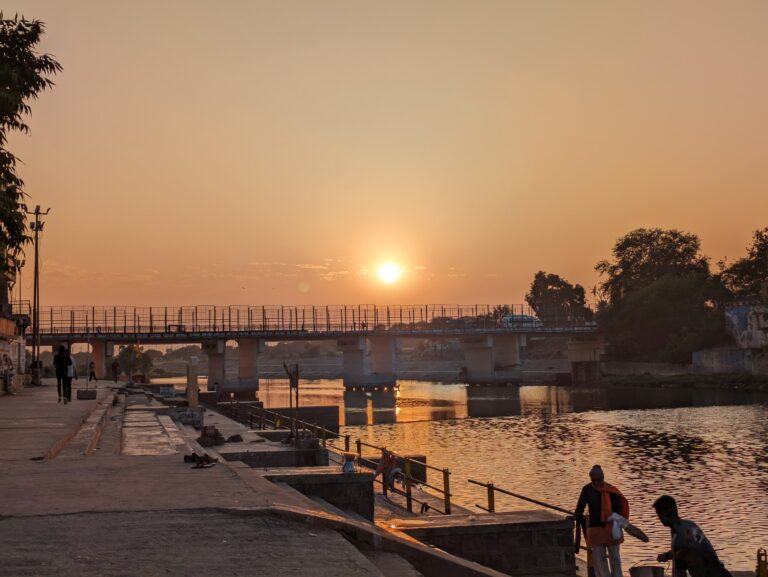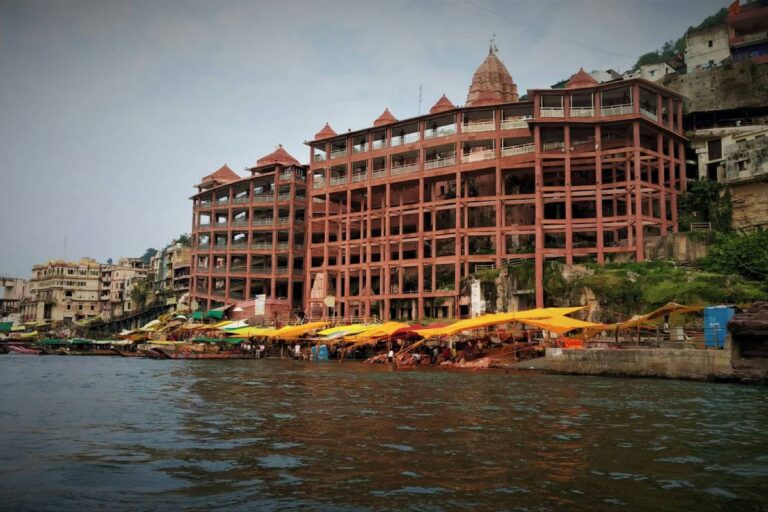

Omkareshwar, a popular tourist destination in Madhya Pradesh, is a sacred site that is thronged by Pilgrims and Shiva devotees throughout the year. This is a place where sacred rivers Kaveri and Narmada meet to form the holy symbol “Om.”
One of the greatest places to visit in India, this tranquil and serene location is well-known for its temples and lush surroundings. Travelers from all over the world come here seeking moksha, peace, and tranquility, and they leave happy and blessed.
During festivals, especially Mahashivratri, Omkareshwar comes alive with religious ceremonies, processions, and devotional music. Travelers can perform various religious rituals and absolve themselves of their sins by dipping into the Narmada River. They can also go on a 7-kilometer Parikrama, stopping at various temples along the way.
Omkareshwar, regarded as one of the holiest pilgrimage sites, offers a plethora of attractions. The revered temple of Shri Omkar Mandhata houses the renowned Jyotirlinga, offering a singular fusion of religion and tranquility.
Omkareshwar’s Religious, Spiritual, and Historical Significance
Ancient Hindu scriptures mention a number of tales associated with Omkareshwar. One story goes that when the wandering Vedic sage Narad Muni came to the Vindhya Mountains, he became angry because there was no home for Lord Shiva in the region. As a result, the God of Vindhya Mountain instituted Tapasya, or abstinence, in order to atone for this error.
He focused his meditations on the earthly lord, who was Lord Shiva. His patience and faith impressed Mahadev (Lord Shiva) and was told that he would live on the island as Pranava Linga. It would be split into Mamleswar and Omkareswar. Mamleswar was an earthly Linga, but Omkareswar was a Jyoti Linga or column of light. They thereafter called the location Omkareswar and built a temple to worship the Jyotirlingam.
The Skanda Purana, Shiv Purana, and Vayu Purana mention Omkareshwar’s religious significance. People believe that those who worship Omkareshwar with unwavering faith in Mahadev find relief from all the evils that exist in the world.
The Best Tourist Destinations In And Around Omkareshwar
Whether travelers are coming for religious reasons or just to get away from the bustle of the city and experience some peace and tranquillity, Omkareshwar has a lot to offer. The place offers a plethora of tourist destinations and activities, such as boat rides, caves, and temples. There is something for everyone seeking spirituality and serenity.
Let’s explore some of the most popular tourist places in and around Omkareshwar which are historically and religiously significant.
Shri Omkareshwar Jyotirlinga Temple
Omkareshwar Jyotirlinga is one of the 12 precious jyotirlingas in India and is regarded as one of the holiest shrines in the nation. The temple sits atop the alluring island of Mandhata, where the Kaveri and Narmada rivers converge. Mandhata Island is even more divine because of its shape, which resembles the holy symbol “OM.”
The temple’s exquisite carvings and Nagara-style architecture are its main features. The exquisite balconies and variously shaped column carvings enhance the temple’s aesthetic appeal. The Jyotirlinga, situated on the temple’s ground level, is always submerged in water. Additionally, there are 20 shrines dedicated to various deities, such as Shani, Ganesh, Krishna, and Narmada.
Mamleshwar Temple
The Mamleshwar temple, also known as Amleshwar or Amareshwar temple, sits on the mainland near the Gomukh ghat on the south.ern bank of the Narmada. Since the Amareshwar of Mamleshwar temple is thought to contain half of the 4th Jyotirlinga—the other half being in the Omkareshwar Temple—it is commonly believed that a pilgrimage to Omkareshwar is incomplete without paying homage there.
Folklore holds that the Pandavas constructed the Shiva lingam at Mamleshwar during their exile from the Mahabharata era. Another well-known Omkareshwar legend states that Mamleshwar Jyotirlinga existed in the Vedic era when Shiva took on the form of a Jyotirlinga in response to the god of Vindhyas’ penance.
Due to the immense assemblage of sages and devotees who flocked to see him, Lord Shiva divided himself into two halves, one on each side of the Narmada River. One of the Jyotirlingas on the island of Mandhata became known as Omkareshwar, while the other on Omkareshwar town’s mainland became known as Mamleshwar. This explains why people sometimes refer to the Amareshwar Jyotirlinga as a Parthivlinga.
Kedareshwar Temple
Kedareshwar Temple is renowned for its elaborate architecture and was constructed as a tribute to Lord Kedar. The temple dates back to the eleventh century and is located only 4 km from Omkareshwar Temple. Its location beside the holy Narmada River only heightens the place’s grandeur.
The Kedarnath temple and Kedareshwar temple are strikingly similar. It continues to be one of the most popular tourist destinations in Omkareshwar as a result. The location’s religious significance draws visitors and devotees from all over the world. Situated along the Parikarma path, the temple offers a magnificent view of the surroundings.
Peshawar Ghat
Peaks split by gorges, clear streams, and grand mountain ranges – Peshawar Ghat is one of those tourist destinations in Omkareshwar that combines religion and beauty. The main reason people come here is to take a holy dip in the Narmada River.
This place is perfect for peace seekers due to its serene surroundings and breathtaking scenery. The best time to visit the Ghat is during Maha Shivratri.
Siddhanath Temple
Siddhanath Temple is said to be the town’s most captivating architectural beauty. It is an old, well-preserved building located on a small plateau on the island of Mandhata. Despite the attack by Mahmud of Ghazni, the temple still stands tall, signifying its power.
The intricate carvings on the temple’s walls and pillars symbolize both its exquisite architecture and spiritual significance. People regard it as one of the main tourist destinations in Omkareshwar because of its exceptional architectural beauty.
The 13th-century temple, which combines Indo-Nagara and Brahminic architectural elements, is the epitome of ancient Indian architectural genius. A massive podium that has mural paintings and figures adorning each of its four sides supports the temple.
Omkar Mandhata Temple
Located on the stunning island of Mandhata, this magnificent temple welcomes millions of pilgrims each year. Built on a pliable stone, the Omkar Mandhata Temple showcases its elaborate artwork. Exquisitely carved stones adorn the shrine, while popular frieze figures decorate the temple’s upper side.
The Omkar Mandhata temple’s majestic architecture is a marvel that draws tourists interested in art and architecture from all over the world. Its elaborate design is a reflection of different architectural styles that have developed over multiple dynasties and historical periods. This illustrates how the temple has managed to hold its cultural and religious significance over time.
Fanase Ghat
One of the several ghats that can be found along the Narmada River’s banks is the Fanase Ghat. The number of worshippers who dip in the sacred river rises on holidays like Diwali, Purnima, and Holi. The ghat thus appears even more magnificent during the festivals.
It takes about two hours to explore the ghat and its surroundings. A fair number of boats are visible here, which transport pilgrims to and from the ghat. The best time of year to visit Fanase Ghat would be from October to March.
Gauri Somnath Temple
The Gauri Somnath Temple, one of Omkareshwar’s many shrines devoted to Lord Shiva, stands on Omkar Parikramapath and is believed to have been constructed in the eleventh century AD. The temple’s enormous Shivlinga and Nandi statue are its most well-known features.
Before Emperor Aurangzeb damaged it, people believed that the temple lingam had the ability to predict future births.. Once this damage was done, the powers were lost forever. Furthermore, nobody else may touch their hands while embracing the lingam from opposite ends except for a pair of uncles and nephews.
In front of the linga, one can also see the idol of Goddess Parvati and Shiva’s consort. One must ascend about 200 stairs in order to catch a glimpse of this stunning star-shaped architectural structure.
Kajal Rani Cave
A list of tourist attractions in Omkareshwar wouldn’t be complete without this well-known location. Kajal Rani Cave, which is only 8 km from Omkareshwar Temple, is a picturesque location that showcases its undulating terrain.
This lovely setting offers a much-needed diversion from the town’s sacred sites. Nature lovers and photographers alike will find Kajal Rani Caves to be a great destination in Omkareshwar. Therefore, if you’ve visited all the temples and sacred sites in Omkareshwar, take your family to these caves and enjoy the breathtaking views of the area.
Sri Govinda Bhagavatpada Cave
Another well-known destination in Omkareshwar is Sri Govinda Bhagavatpada Cave, which has a connection to the revered Indian saint Adi Shankaracharya. Govinda Bhagavatpada Granth taught Guru Shankaracharya his lessons in this cave.
According to legend, Adi Shankaracharya traveled thousands of miles by foot through deep forests, valleys, and towering mountains to reach Govinda Bhagavatpada, who lived in a cave beside the pure Narmada River.
Additionally, people believe that Shankaracharya prevented a large flood from damaging the town by channeling river water into a kamandalu, a small bowl placed next to the cave’s entrance.
Jhula Pul
One of the greatest locations to visit close to Omkareshwar is Jhula Pul. This location holds great historical significance for Omkareshwar and has served as a vital link between the mainland and Omkareshwar Island for many years. The bridge offers a breathtaking view of the surrounding countryside while spanning the revered Narmada River. Tourists frequently visit this location to enjoy a leisurely stroll or to capture picturesque images of the town and river.
Gomukh Ghat
The Gomukh Ghat’s name comes from the naturally occurring water spouts that resemble cows’ mouths. Before going to the temple to worship, devotees bathe at this location, which is close to the Omkareshwar Temple.
Photographers hoping to capture the spirit of life along the Narmada river will also find this to be an excellent location. Gomukh Ghat’s early mornings are bustling with rituals and a chance to witness customary aartis and offering ceremonies.
Devotees regard Gomukh Ghat as a sacred place for bathing, believing that bathing in the Narmada River there washes away sins. It is also among the best tourist destinations in Omkareshwar and offers a serene setting for yoga, meditation, and introspection.
Rinmukteshwar Temple
The Rin Mukteshwar Mahadev Temple is located on the Omkareshwar-Parikrama/Omkar-Parvat on the banks of Narmada Kaveri Sangam. The Pandavas constructed it during their AGYATWAS.
When the Pandavas asked Lord Krishna why they were suffering, God explained that it was because of Pitra-Rina, or their ancestor’s debt. Simultaneously, he explained the importance of honoring Lord Shiva as Rin Mukteshwar.
Next, the Pandavas constructed a temple and worshipped Lord Rin-Mukteshwar on the banks of the Narmada Kaveri Sangam. During their Agyatwas, the Pandavas built a Shivlinga by making penances to Lord Shiva in order to settle their debts.
Ahilya Ghat
Ahilya Ghat, situated close to Omkareshwar Temple on Mandhata Island in Omkareshwar, is a revered and picturesque spot. It bears the name after the well-known queen Ahilyabai Holkar who ruled the Malwa region in the eighteenth century.
As a devotee of Shiva, she constructed numerous temples and ghats beside the Narmada River. Ahilya Ghat draws travelers and pilgrims alike because of its spirituality, culture, and natural beauty.
Anybody who wishes to feel the serene and holy atmosphere of the Narmada River must visit Ahilya Ghat. The ghat offers a wide view of the river and the hillsides beyond. A statue of Ahilyabai Holkar is also present on the ghat, serving as a reminder of her legacy and devotion. In addition, the ghat is the site of numerous religious and cultural events.
Narmada Kaveri Sangam
Because it is the confluence of the two sacred rivers, the Narmada and the Kaveri, this location is unique. These rivers are highly revered and significant from a religious standpoint. On pilgrimages, people come here to offer prayers, carry out rites, and look for blessings.
In order to atone for their sins and achieve spiritual purity, devotees take holy baths in the river here. Taking a boat ride on the serene Narmada River and taking in the stunning scenery around it is one of the best things to do here.
Best Time To Visit Omkareshwar
All year long, the gates of Omkareshewar are open to devotees. You can take Lord Shiva’s blessings during the appointed hours, and you can also enjoy the serene and lovely surroundings.
The monsoon season to early summer, when the weather is pleasant and conducive to exploration, is the ideal time to go. But because of the intense heat and high temperatures, summer is usually regarded as an off-season, so it might not be ideal for everyone.
Summer: Early summer sees several auspicious festivals, especially Mahashivaratri in March, which many people widely observe. Being a part of Omkareshwar and taking in the festive atmosphere is very exciting during this time.
On the other hand, because of the intense heat and intense temperatures, the summer months of April through June are regarded as the off-season. However, because there are fewer people around, visitors can take their time exploring each temple.
Monsoon: The monsoon in July provides a reprieve from the scorching temperatures and attracts a lot of tourists. Most people can enjoy the cool, breezy weather during this time of year, and there is a sizable crowd outside the temple.
Winter: From October onwards, when the temperature starts to drop comfortably, winter is another fantastic season to visit Omkareshwar. But bear in mind that winter is the busiest travel season, so expect long lines and crowds outside the temple. We especially suggest February because of the Mahashivratri celebrations and festivities, which offer an unforgettable experience.
How Can One Get To Omkareshwar?
The city of Omkareshwar is situated in the center of India. The city connects well to different regions of the nation, and you should consider the following modes of transportation to get to Omkareshwar:
By Air : Devi Ahilyabai Holkar Airport in Indore, which is roughly 77 km north of the city, is the closest airport to Omkareshwar. There are strong connections between this airport and the nation’s largest cities. It is simple to locate a bus or taxi to go to Omkareshwar from the airport.
By Rail: Omkareshwar Road (Mortakka) Railway Station is the name of the town’s railway station. Situated on the Ratlam-Khandwa railway line, it is 12 km away from the main city. There are excellent connections between this train station and the nation’s largest cities. Road transportation to Omkareshwar is readily available from the railway station.
By Road: If you’d rather travel by car, you can go from nearby Madhya Pradesh cities to Omkareshwar. These are some approximations:
Khandwa: 70 kilometers or so via the Mundi-Sanawad Road.
Indore: About 80 km via NH 347BG and Icchapur Road.
About 138 km via NH 347BG to Ujjain.
Bhopal: About 260 km via NH 86 and Kannod Road.
Conclusion
Omkareshwar holds immense religious and spiritual significance among Lord Shiva devotees from all around the world. Devotees flong this place to take holy dip in the sacred Narmada river and then take Shiva’s blessings.
The place seems more lively during festivals such as Mahashivratri when people carry out various religious activities. Apart from the Omkareshwar Jyotirlinga temple, the article mentions many other religiously and historically significant places.
If you are planing to visit Omkareshwar, visiting these places can be a once in a lifetime experience for you. You can get in touch with us if you want to plan your visit to Omkareshwar. We have many tour packages which cover your entire Omkareshwar tour.
Hope this article was helpful. Let us know your thoughts in the comments.