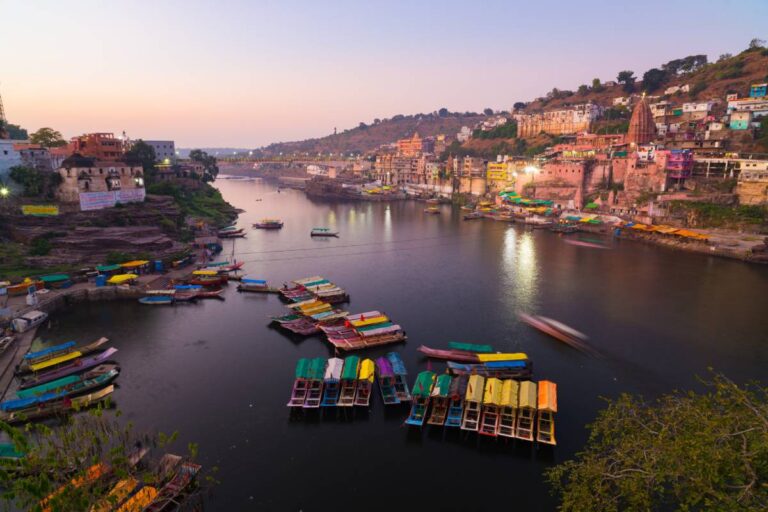

The Omkareshwar Temple, situated in Madhya Pradesh, is one of the most well-known and highly esteemed Hindu temples in India. The temple devoted to Lord Shiva is also one of the 12 Jyotirlingas.
Lord Shiva’s sacred shrines, known as Jyotirlingas, hold a special place in the hearts of their devotees. It is thought that Lord Shiva personally visited these locations.
“Column or pillar of light” is what Jyotirlinga means. The “stambha” symbol represents the idea that there is no beginning or end.
Following a dispute between Lord Brahma and Lord Vishnu over who was the greatest god, Lord Shiva manifested as a column of light and asked each to locate the ends. Neither was able to succeed. It is thought that the jyotirlingas are situated in the areas where these columns of light have fallen.
The temple sits on an island called Mandhata, named after the mythological King Mandhata in Hindu mythology. According to legend, King Mandhata came here to seek Lord Shiva’s blessings through penance.
About Omkareshwar Temple
The Jyotirlinga of Omkareshwar is located on the island of Mandhata, close to the banks of the Narmada River. Additionally, Hindu holy books like the Vedas and Puranas contain references to the temple. Therefore, spiritual seekers should not miss visiting Omkareshwar, which is home to 33 deities and six pilgrimages in total.
The Narmada’s curved shape, representing “Om,” adds even more ethereal quality to this holy place. Shiva’s enduring religious influence on his followers and the long-standing Hindu customs are embodied in Omkareshwar. People believe that Lord Shiva made his Omkara Swaroopa appearance at this temple.
The Vayu Purana, the Shiv Purana, and the Skanda Purana all discuss Omkareshwar’s religious significance. It is said that anyone who worships Omkareshwar with unwavering faith in Mahadev will find relief from all of the world’s evils.
A lot of couples go to the Omkareshwar temple and follow different rituals. Devotees do this to receive blessings from Bholenath (Lord Shiva) for healthy offspring and a happy life. The temple priests say that performing a Parikrama, or circle around the temple, will bring you a bright future and Moksha, or salvation, after death.
Significance of the Temple
The Omkareshwar Temple is one of the most sacred places for followers of Lord Shiva, and is of great significance in Hinduism. In order to receive Lord Shiva’s blessings and feel the spiritual aura of this hallowed location, pilgrims travel from all over India and even beyond.
The temple is especially well-known due to its association with Lord Shiva’s Jyotirlinga. Visiting one of the twelve Jyotirlingas, which people regard as Lord Shiva’s most powerful incarnations, is believed to bestow spiritual merit and release from the cycle of life and death. For those who follow Shiva, a visit to Omkareshwar—one of the twelve Jyotirlingas—is an essential component of their sacred journey.
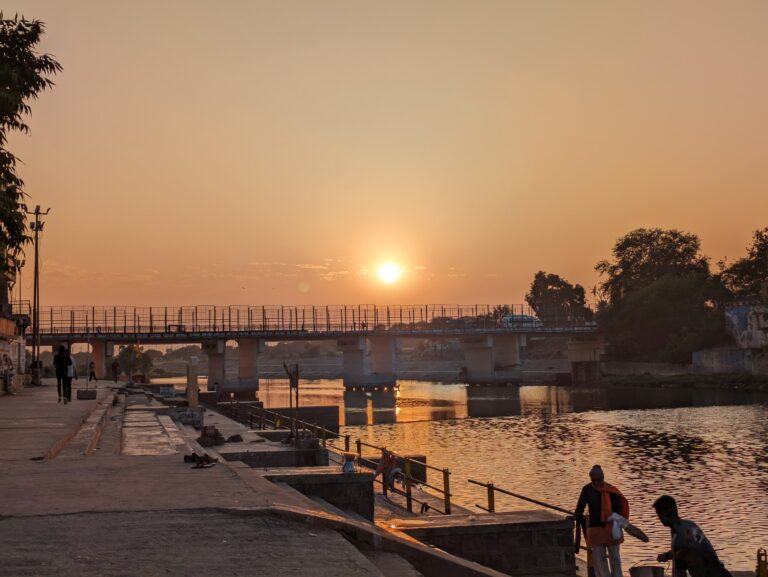
The Narmada River encircles the island where the temple is located, making it an extremely auspicious site for worship. People say that bathing in the Narmada River, regarded as a holy river, can atone for sins and purify the soul. As a sign of devotion, pilgrims frequently perform a parikrama of the entire island.
Additionally, Omkareshwar is particularly significant to scholars and knowledge seekers. For centuries, it has served as a hub for the study of Hindu scriptures and philosophy. The temple is a great place for contemplation and meditation because of its calm surroundings and spiritual energy.
The temple attracts a wide range of pilgrims, including saints, sadhus, academics, and regular devotees. It serves as a center for spiritual and cultural exchange in addition to being a place of worship.
The story behind Omkareshwar Jyotirlinga
According to legend, the extreme austerities performed by two sons of the Ikshvaku emperor Mandhata pleased Lord Shiva, who then named the mountain Mandhata. And Lord Shiva made his appearance as a jyotirlinga.
According to a different legend, Vindhya Parvat begged Lord Shiva to make the Vindhyas his abode by undergoing great penance. Some claim that its goal was to surpass Mount Meru in height. The penance pleased Lord Shiva, who fulfilled his wish to appear there as a jyotirlinga.
Lord Shiva divided the linga into two parts at the request of the gods and sages; one is located at Omkareshwar, and the other at Amareshwar or Mamleshwar. Thus, when pilgrims travel to Mandhata, they pay homage to both of these temples.
Unique Facts About the Omkareshwar Temple
- The temple sits on Omkareswar Island, which a valley divides into two parts forming the sacred Hindu symbol “Om”
- According to archaeologists, a larger complex was constructed around the Jyotirlinga, which was originally housed inside a tiny ancient temple.
- According to many Hindu saints, worshiping the Omkareswar Jyotirlinga is equivalent to worshiping Kedarnath and the Panch Kedar which are the two well-known Hindu pilgrimages.
- People believe that Lord Shiva himself comes to the temple each night to sleep, hence they perform the Shayan Aarti here.
- Renowned Hindu scholar Swami Gajanand Saraswati claims that people originally constructed the temple 7,99,25,105 years ago. He supported this information with citations from Skand Puran’s Prabhas Khand.
- The Skanda Purana states that there have been six Brahmas thus far, and the seventh Brahma, also referred to as the Shatanand, is the present-era one. In the last Yuga, people knew the temple as Mrityunjaya, but they called it Somnath during the seventh.
Omkareshwar Parikrama
A large number of pilgrims perform a full parikrama around Omkareshwar Island. The Parikrama Path is a 7-kilometer circular path that circles Omkar Hill and has multiple staircases. There are numerous temples and ashrams along the Parikrama path. Along the route is the meeting place of two rivers.
The Gauri Somnath Mandir, Omkareshwar Matt, Patali Hanuman Mandir, Rin Mukteshwar Temple, and Shiva Pratima Mandir are a few significant shrines along the path. Don’t forget to take a bath at the Kaveri and Narmada river confluence.
Architectural Significance
The temple features a large sabha mandapa, standing about 14 feet high, supported by 40 enormous pillars adorned with Yakshi figures. Furthermore, the temple consists of five stories, housing different deities namely Shree Omkareshwar, Shree Mahakaleshwar, Shree Siddhanath, Shree Gupteshwar, and Dhwajdhari Shikhar.
They built the temple out of soft stone, which surprisingly contains a remarkable amount of detail, including an intricately carved stone roof and frieze figures on the upper portion.
The temple features a large sabha mandapa, standing about 14 feet high, supported by 40 enormous pillars adorned with Yakshi figures. The temple consists of five stories, housing different deities namely Shree Omkareshwar, Shree Mahakaleshwar, Shree Siddhanath, Shree Gupteshwar, and Dhwajdhari Shikhar.
Within the temple complex are the hallowed shrines of Panchamukhi Ganesha and Annapoorna Devi. The temple also honors Lord Shani, Devi Narmada, and Lord Krishna.
Partially submerged in water, the Jyotirlinga is situated in the ground floor’s sanctum sanctorum. The Jyotirlinga is located on the side of the Omkareshwar temple rather than beneath its Sikhara. This makes it stand out from other temples.
Poojas Done at Omkareshwar
The Poojas done at Omkareshwar Temple include Maha Rudrabhishek, Laghu Narmada Aarti, Bhagavan Bhog, Mundan, Tuladaanam, and Parthiv Shivling Pooja.
Maha Rudrabhishek involves the recitation of Rigveda, Samaveda, Yajurveda, and Atharva Veda in front of the Linga to please Lord Shiva. Additionally, they perform the Laghu Narmada Aarti every evening on the banks of the River Narmada. Moreover, Bhagavan Bhog is an offering of food to Lord Shiva in the evening.
Mundan is a hair cutting ritual at the temple. Parthiv Shivling Pooja is a specific request Pooja where 1008 Shiva Lingas are made with mud or wood. Their Abhishekam is done to overcome health and wealth-related issues and cure diseases, accidental injuries, and misfortune.
How to reach Omkareshwar
To reach Omkareshwar, there are several transportation options available. The nearest airport to Omkareshwar is the Indore Airport, which has good connections to major cities in India. From Indore, you can hire a taxi or take a bus to reach Omkareshwar, which is approximately 77 miles away.
The Omkareshwar Road railway station, closest to Omkareshwar, connects well with major cities like Indore, Bhopal, and Ujjain. Once you reach the railway station, you can hire a taxi or take a bus to reach Omkareshwar town.
Additionally, roads connect Omkareshwar well to cities like Indore, Bhopal, and Ujjain. You can either hire a taxi or take a bus to reach Omkareshwar. Overall, there are several transportation options available to reach Omkareshwar, making it convenient for visitors from various parts of India.
Conclusion
The Omkareshwar Temple is a testament to India’s rich spiritual and cultural legacy. For millions of people, it is a site of intense devotion and reverence because of its religious significance, architectural beauty, history, and legends. In addition to offering a calm and revered environment for those seeking spiritual enlightenment, the temple represents the divine presence of Lord Shiva.
Traveling to the Omkareshwar Temple is a cultural and historical adventure in addition to a religious one. It enables people to fully immerse themselves in Hinduism’s age-old customs and wisdom and establish a spiritual connection with their spiritual roots. The Omkareshwar Temple still holds a timeless and sacred status in India, serving as a hub for devotion, learning, and cross-cultural interaction.